Why Talking Therapy does not need to involve much talking:
Psychodynamic Therapy with Autistic and ADHD Children
Children and young people with autism and ADHD can sometimes struggle to engage in traditional talking therapies.
This is not always obvious at first. In fact, many neurodivergent children can appear to be engaging very well. They may sit politely, answer questions, say what they think the adult wants to hear, and go through the motions of therapy without anything really changing at a deeper level.
This can be particularly true for girls who have learned to mask. A child may not tell their therapist, or even their parent, that therapy does not feel helpful or accessible. The problem may only become clear when they begin to avoid sessions, ask to stop coming, or simply seem to get nothing from the work.
By then, the therapist may never know the real reason for the non-attendance or premature ending.
This is one of the reasons I think traditional talking therapy can miss something important with neurodivergent children. And this is why we use a play-based approach in psychodynamic and psychoanalytic psychotherapy.
“Psychotherapy takes place in the overlap of two areas of playing, that of the patient and that of the therapist. Psychotherapy has to do with two people playing together.”
D. W. Winnicott, Playing and Reality, “Playing: A Theoretical Statement”.
The “good therapy patient”
One of the things I often think about is the child who becomes a “good” therapy patient.
They know how to answer. They know how to appear thoughtful. They know how to give the adult enough to keep the conversation going. But the work can remain very much on the surface.
A neurodivergent child may be very skilled at gauging what adults want from them. They may have spent years learning how to perform being fine, being cooperative, being bright, being easy, being polite. Therapy can become another place where this performance continues.
Even a well-meaning therapist can become blind to this. If we rely too much on what the child says, we may miss what the child is showing us.
A child may talk, but not really be met.
They may comply, but not really use the therapy.
They may appear engaged, while remaining deeply defended.
This is why I do not think of play, drawing and games as secondary to the “real” therapy. With many children, they are the therapy.
Why play and art matter
In psychodynamic child psychotherapy, play and art are not used simply to make therapy more fun or child-friendly. They are ways the child communicates.
The therapist is not only listening to the child’s words. The therapist is also listening to the play, the drawing, the rhythm of the session, the repetitions, the rules the child creates, the mistakes, the silences, the winning, the losing, the avoiding, the controlling and the inviting in.
The child may not say, “I find it hard to share my world with another person.”
Instead, they may play alone every week and never involve the therapist.
The child may not say, “Mistakes feel unbearable.”
Instead, they may screw up a drawing the moment a tiny line goes wrong.
The child may not say, “I only feel safe when I know exactly what is going to happen.”
Instead, they may draw the same house every week, or play the same game in the same way, with the same rules, and become distressed if anything changes.
These are communications. They need to be noticed, thought about and handled carefully.
The toy or equipment box matters as much as the therapy room
In child psychotherapy, each child has their own box. This might include toys, figures, paper, pens, art materials, games or other objects that become meaningful to that child over time.
The box matters because it gives the child continuity. It also allows patterns to emerge.
A child may return to the same object again and again. They may organise the materials in a particular way. They may avoid certain toys. They may control the box very carefully. They may become distressed if something has moved. They may use the materials freely, or barely use them at all.
Over time, the therapist begins to understand something about the child’s internal world through the way they use the box.
For neurodivergent children, this can be especially important because the play may show what words cannot yet express.
When a child plays alone
A child may come into the room and play very independently.
At first glance, this can look like confidence. They know what they want to do. They do not need help. They seem settled.
But I might also wonder why I am not being invited in.
Is it hard for them to share the play?
Does another person’s mind feel intrusive?
Are they unsure how to include me?
Do they need to keep control in order to feel safe?
Have they learned to manage alone because depending on another person feels too risky or unpredictable?
I might gently draw attention to this. Not by forcing my way into the game, but by wondering with the child about what is happening between us.
I might say something like:
“I notice you know exactly what you want to do, and I’m not really part of the game yet.”
Or:
“It seems like it might be hard to let me have an idea too.”
This kind of work can help a child begin to notice the interpersonal aspects of what they are doing. It is not social skills training in a simple behavioural sense. It is a live emotional experience of being with another person, noticing another mind, and gradually finding ways to share, tolerate, reject, include or negotiate.
For some neurodivergent children, this is where meaningful therapeutic work begins.
When mistakes feel unbearable
Another common moment in therapy is the child who screws up a drawing the second something goes wrong.
The mistake might be tiny. A line is not quite right. A colour goes outside the edge. The picture does not match what they imagined.
Suddenly the whole drawing is ruined.
This can tell us a lot.
For some children, mistakes are not experienced as ordinary. They feel catastrophic. The child cannot keep the imperfect thing in front of them. It has to be destroyed, hidden or started again.
This is often linked to rigidity, perfectionism and a low tolerance of uncertainty. It can be particularly common in neurodivergent children who rely on control and predictability to manage anxiety.
In the session, I might gently point to what has happened:
“It seems like once the drawing went a bit wrong, it felt impossible to keep it.”
Or:
“I wonder if the mistake made the whole thing feel ruined.”
This is not about persuading the child that mistakes are fine. That would usually be too quick. It is about helping the child begin to notice what happens inside them when something unexpected or imperfect appears.
Over time, the child may become more able to pause before destroying the drawing. They may repair it, change it, keep it, laugh about it, or tolerate it being unfinished.
That may sound small, but it is not small.
The ability to tolerate mistakes is closely connected to the capacity to learn, to play, to be creative, to try something new, and to survive not knowing in advance how things will turn out.
When the same drawing appears every week
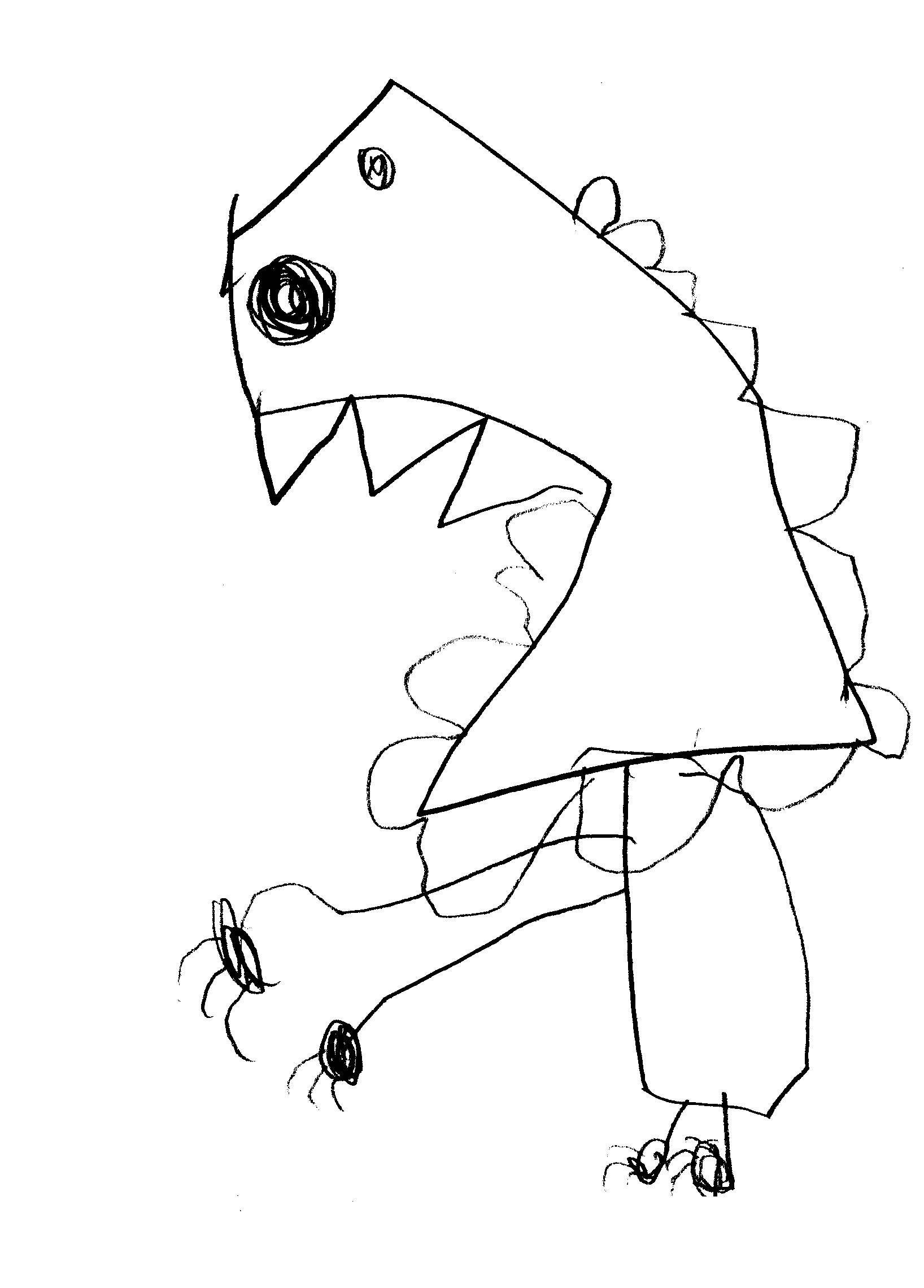
Some children draw the same thing again and again.
A house. A road. A map. A character. A creature. A battle. A machine. A very carefully organised scene.
It can be tempting to think, “They are just drawing the same thing again.” But repetition is often meaningful.
I might wonder:
Why this image?
Why again?
What does it protect?
What does it hold?
Is it familiar enough to feel safe?
Is the child worried they will not know how to draw something else?
Is there a fear of doing it wrong?
Is there something about this image that needs to be returned to before it can change?
In therapy, I often notice that over time the artwork becomes more diverse. The child may add something new. The house changes. The map expands. The character develops. A new colour appears. The child takes a small risk.
This can point to a greater tolerance of uncertainty. The child begins to move beyond the safety of repetition into something more flexible and creative.
That shift matters.
It may show that the child is becoming more able to imagine, experiment, recover from mistakes, and allow something unknown to emerge.
When a child cannot play freely
Some children cannot easily free themselves enough to play. Even this cannot be expected as a given. Winnicott and other notable psychoanalysts saw play as a developmental achievement. Children can only play when they feel safe and comfortable, usually after a short or longer period of “getting to know” the therapist.
However, this lack of freedom to be playful, creative and curious may be more entrenched and linked to psychological and emotional difficulties. Some children may struggle, even after getting to know the therapist, to feel safe and confident enough to have a wish or desire for how they want to play, or what they would like to spend the session doing. Many neurodivergent children can be afraid of getting it wrong and rely on the adults to lead the way.
They may ask what they are supposed to do. They may feel exposed by open-ended tasks. They may reject free drawing. They may not know how to begin. They may need more structure before they can use the space.
In these situations, I may take a more active role.
I might suggest a game. I might offer a drawing task. I might introduce word association or free drawing. I might help create just enough structure for the child to feel safe enough to begin.
This does not make the work less psychodynamic. It means adapting the frame so that the child can actually use it.
For some children, too much freedom feels like falling. They need a bridge into play.
Games in the therapy room
Games can be very revealing.
A game like Connect 4 may seem simple, but it can bring up frustration, competition, impulsivity, the wish to win, the difficulty of losing, the need to control the rules, or the tendency to repeat the same game over and over again.
For a child with ADHD, this might help us think about waiting, turn-taking, losing, excitement, disappointment and impulse.
For a child who finds uncertainty difficult, the game may become very controlled. The child may change the rules, avoid losing, or insist on playing in one particular way.
Again, the point is not simply to teach the child to lose nicely.
The point is to understand what losing feels like. What does it stir up? Shame? Rage? Collapse? Humiliation? Panic? A feeling of being stupid? A feeling that the other person has become cruel or triumphant?
When this can be thought about in the relationship with the therapist, the child may gradually develop more room between feeling and action.
Why this matters for parents
Parents often come to therapy hoping their child will be able to talk more, explain more, cope better, attend school, tolerate frustration or manage feelings differently.
These are understandable hopes.
But sometimes the most important work begins before the child can explain anything clearly.
A child may show their difficulty through the way they play, draw, avoid, repeat, control, collapse, comply or perform.
With neurodivergent children, this requires particular care. We need to think about what belongs to autism or ADHD, what belongs to anxiety, what belongs to masking, what belongs to sensory overload, what belongs to relationships, and what belongs to the child’s inner emotional world. If we move too quickly, we can miss the child.
A different kind of listening
Psychodynamic therapy with autistic and ADHD children is not about making the child less neurodivergent.
It is about listening more carefully to the child’s own forms of communication.
Sometimes that communication comes through words. Often it comes through play, art, games, repetition, silence, refusal, rules, mistakes or the relationship with the therapist.
My task is to notice these communications and help the child, and sometimes the parents, think about them.
Not everything needs to be interpreted immediately. Not everything needs to be explained. But over time, when the child feels that their communications are being understood rather than simply managed, something can begin to shift.
The child may become less defended.
More able to play.
More able to tolerate mistakes.
More able to share their world.
More able to risk not knowing.
More able to be met as they are, rather than as the “good” version of themselves they have learned to perform.
That is often where the deeper work begins.
Further reading and related guidance
This piece is written from my own clinical experience and psychoanalytic child psychotherapy training. Parents may also find the following guidance useful:
• NICE, Autism spectrum disorder in under 19s: support and management, CG170.